
(CITY)Lemon Law Laywer - Free Case Review
Stop the Runaround. Start the Resolution.
You don’t have to put up with a lemon.
You could receive a full refund or a new car plus cash back at no cost to you!
Free case review nowYou could receive a full refund or a new car plus cash back at no cost to you!
(CITY) drivers are choosing Driver Defense Group for Lemon Law Legal Services!
We have settled thousands of cases and know the (COUNTY) landscape. Most cases end in a buyback, replacement, or cash settlement.
When you work with us, you are likely to “get your money back” and more! Our group has a 99% success rate in lemon cases.
When you work with us, you are likely to “get your money back” and more! Our group has a 99% success rate in lemon cases.
⬇️ Confirm Eligibility in 30 seconds! ⬇️
ZERO out of pocket cost & FAST EASY HASSLE FREE Process
You won’t pay a dime – even our consultation is free!
How Your Lemon Law Claim Works
1) We gather records & handle everything
We do all the legwork. We gather the records and prepare a demand package.
2) You get paid!
We negotiate a buyback, replacement, or cash+keep outcome. Manufacturers know they have to cover all attorney’s fees when you win, which makes them settle quickly.
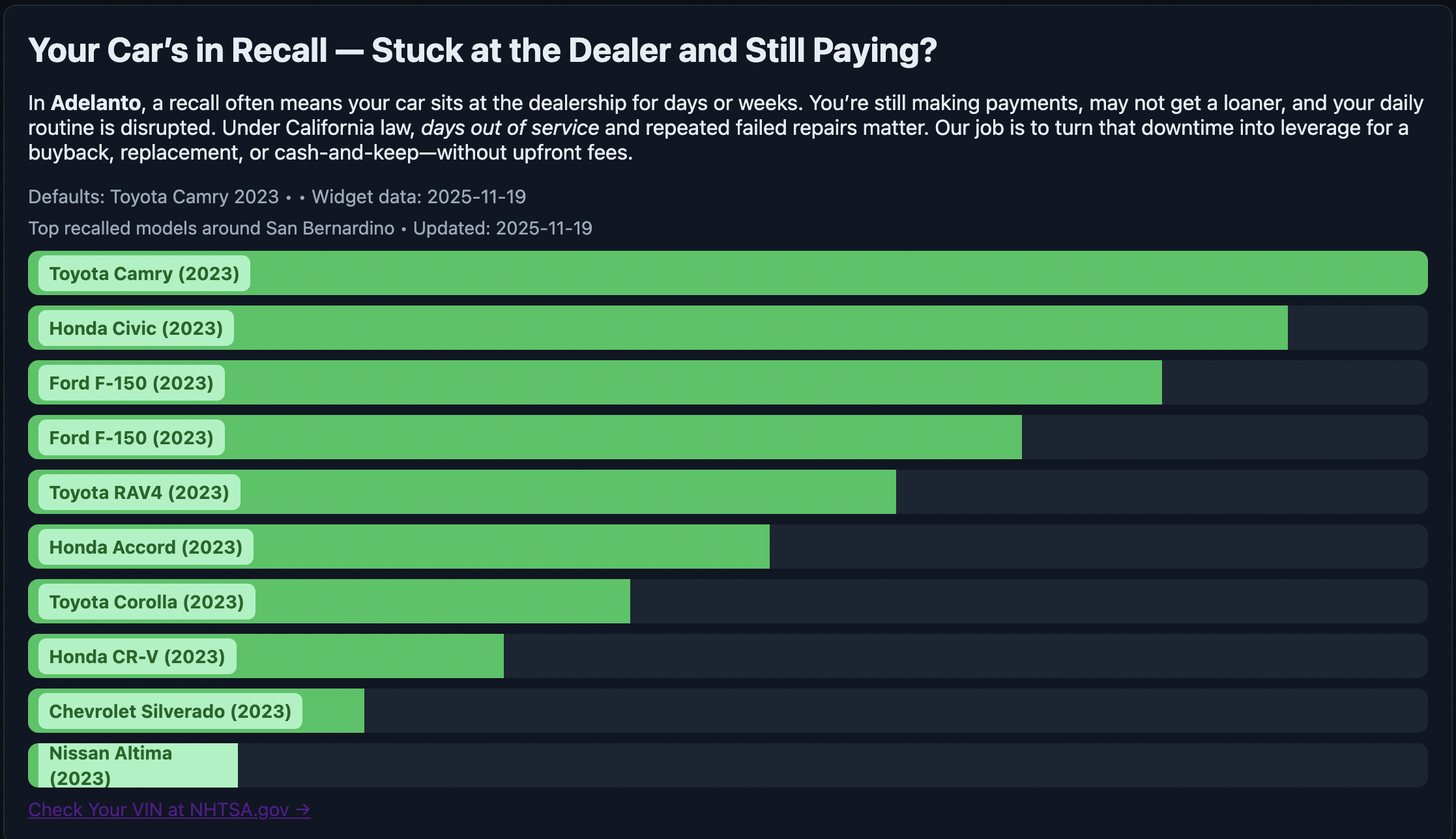
Free case review nowYour Car’s in Recall or Has Issues — Stuck at the Shop and Still Paying?
In {City}, a recall or breakdown often means your car sits at the dealership for days or weeks. You’re still making payments, may not get a loaner, and your routine is upside down.
We use that downtime as leverage for a buyback, replacement, or cash-and-keep—with guarenteed zero cost to you.
We use that downtime as leverage for a buyback, replacement, or cash-and-keep—with guarenteed zero cost to you.
Top recalled models around San Bernardino • Updated: 2025-11-19
If your car has been out of commission for more than 30 days, you're not alone. You could be eligible to not only get a full refund, but recieve bonus commpensation from the manufacturer for your inconvience!
Answers to Common Questions
What are my rights under California’s Lemon Law?
When a “lemon” car – one with defects affecting its use, value, or safety – can’t be repaired after a reasonable number of attempts, the owner is entitled to a refund, replacement, or cash compensation at the manufacturer’s expense
What qualifies my car under California’s Lemon Law
Chronic Vehicle Defects
The car has major mechanical or electrical problems that persist despite multiple repair attempts.
Common culprits are transmission failures, engine problems, and electrical system malfunctions, which are among the top issues cited in lemon law claims .
For example, in recent years many lemon cases involved engine or transmission defects (e.g. Ford F-150 transmission issues, Jeep Cherokee engine trouble) that “substantially impair the use or safety” of the vehicle .
Modern cars are packed with complex tech (software, sensors, EV batteries), so newer models can be more fragile – a recent uptick in vehicle recalls (up 8% in CA in 2024) shows how high-tech components like EV software and autonomous features are failing and leading to lemon claims.
In short, manufacturing defects that can’t be fixed prompt consumers to seek a buyback or replacement under the law.
Common culprits are transmission failures, engine problems, and electrical system malfunctions, which are among the top issues cited in lemon law claims .
For example, in recent years many lemon cases involved engine or transmission defects (e.g. Ford F-150 transmission issues, Jeep Cherokee engine trouble) that “substantially impair the use or safety” of the vehicle .
Modern cars are packed with complex tech (software, sensors, EV batteries), so newer models can be more fragile – a recent uptick in vehicle recalls (up 8% in CA in 2024) shows how high-tech components like EV software and autonomous features are failing and leading to lemon claims.
In short, manufacturing defects that can’t be fixed prompt consumers to seek a buyback or replacement under the law.
Multiple Failed Repair Attempts
A key trigger for invoking the law is when the authorized dealer cannot fix the defect after a “reasonable” number of tries.
The dealer has 2–4 attempts (fewer if it’s a serious safety issue) and the vehicle cannot be out of service for 30+ days.
At that point, frustration peaks. Drivers lose confidence in the car’s reliability – “when a new vehicle has ongoing problems, it becomes difficult to trust that it will be safe to drive”, causing daily uncertainty and stress.
The dealer has 2–4 attempts (fewer if it’s a serious safety issue) and the vehicle cannot be out of service for 30+ days.
At that point, frustration peaks. Drivers lose confidence in the car’s reliability – “when a new vehicle has ongoing problems, it becomes difficult to trust that it will be safe to drive”, causing daily uncertainty and stress.
Safety and Financial Concerns
Many lemons pose safety risks (e.g. brake failures or stalling engines), which understandably alarms consumers.
The threat of accident or injury because of an unfixable defect is unacceptable . Additionally, owners worry about financial loss: the car’s value drops due to its repair history, yet they’re stuck with loan payments or a useless vehicle.
This combination of safety hazards, inconvenience, and economic loss leaves consumers feeling cheated, which is exactly the scenario the lemon law is meant to remedy.
The threat of accident or injury because of an unfixable defect is unacceptable . Additionally, owners worry about financial loss: the car’s value drops due to its repair history, yet they’re stuck with loan payments or a useless vehicle.
This combination of safety hazards, inconvenience, and economic loss leaves consumers feeling cheated, which is exactly the scenario the lemon law is meant to remedy.
Unethical Dealer or Manufacturer Behavior
in many cases, it’s not just the defect but also how the dealership/manufacturer handles it that forces consumers to invoke the law. Unfortunately, some dealers and automakers employ delay or denial tactics to avoid a buyback. Common strategies include blaming the problem on “normal” use or driver misuse, offering Band-Aid fixes or extended warranties instead of a refund, delaying repair appointments or parts for weeks, and insisting on excessive repair attempts before admitting the car is a lemon . These bad-faith tactics wear down the customer’s patience. In California, we’ve even seen practices like “lemon laundering,” where a manufacturer repurchases a lemon vehicle but then resells it at auction or out-of-state without disclosing its history . An unsuspecting used-car buyer might unknowingly purchase a prior buyback vehicle that still has unresolved defects – essentially a recycled lemon. If the dealership lied about a used car’s history or condition, or tells an owner “you don’t qualify for lemon law” when they actually do (sometimes persuading them to trade in the car instead) , the customer has been misled. These unethical behaviors often create lemon law cases: consumers turn to attorneys because the dealer/manufacturer isn’t honest or cooperative, leaving legal action as the only way to get justice.
How long does a Lemon Law case take in California?
iskdkdka
Does the Lemon Law apply to used or leased cars in {City}?
This law covers vehicles purchased or leased in California with a manufacturer’s warranty, including certified pre-owned (CPO) cars sold with remaining warranty coverage.
California’s AB 1755 (effective April 2025) now explicitly covers certified used cars with remaining manufacturer warranties and extended the filing deadlines.
About 25% of lemon lawsuits in 2025 involve used vehicles, up from a much smaller share before. This confirms what many suspected: dealers selling “lemony” used cars is a real issue, and now consumers are pursuing those cases in greater numbers.
California’s AB 1755 (effective April 2025) now explicitly covers certified used cars with remaining manufacturer warranties and extended the filing deadlines.
About 25% of lemon lawsuits in 2025 involve used vehicles, up from a much smaller share before. This confirms what many suspected: dealers selling “lemony” used cars is a real issue, and now consumers are pursuing those cases in greater numbers.
Thank you! Your submission has been received!
Oops! Something went wrong while submitting the form.
.png)